FR
FR  DE
DE 
A great lesson goes beyond just selecting off-the-shelf drills and giving feedback on how to do them. Aim for a structured process which is tailored to both the learners and the surrounding context.
At BASI Level 2, instructors are expected to plan, deliver, and adapt purposeful, learner-centred, and outcome-driven sessions. The TIED model provides a clear, repeatable structure to achieve this, helping instructors move from activity-based teaching to intentional coaching in which every choice directly relates to learner needs and session outcomes.
The Role of Teaching at BASI Level 2

At Level 2, BASI instructors must demonstrate the ability to:
- Teach intermediate skiers or riders safely and effectively in varied environments.
- Adapt sessions to suit differing learning styles, performance levels, and contexts.
- Diagnose performance issues accurately and select suitable solutions.
- Reflect and evolve the session based on real-time evaluation.
The TIED model supports these outcomes by providing a logical cycle for continuous planning, delivery, and refinement – fundamental to developing adaptable instructors.
What Is the TIED Model?
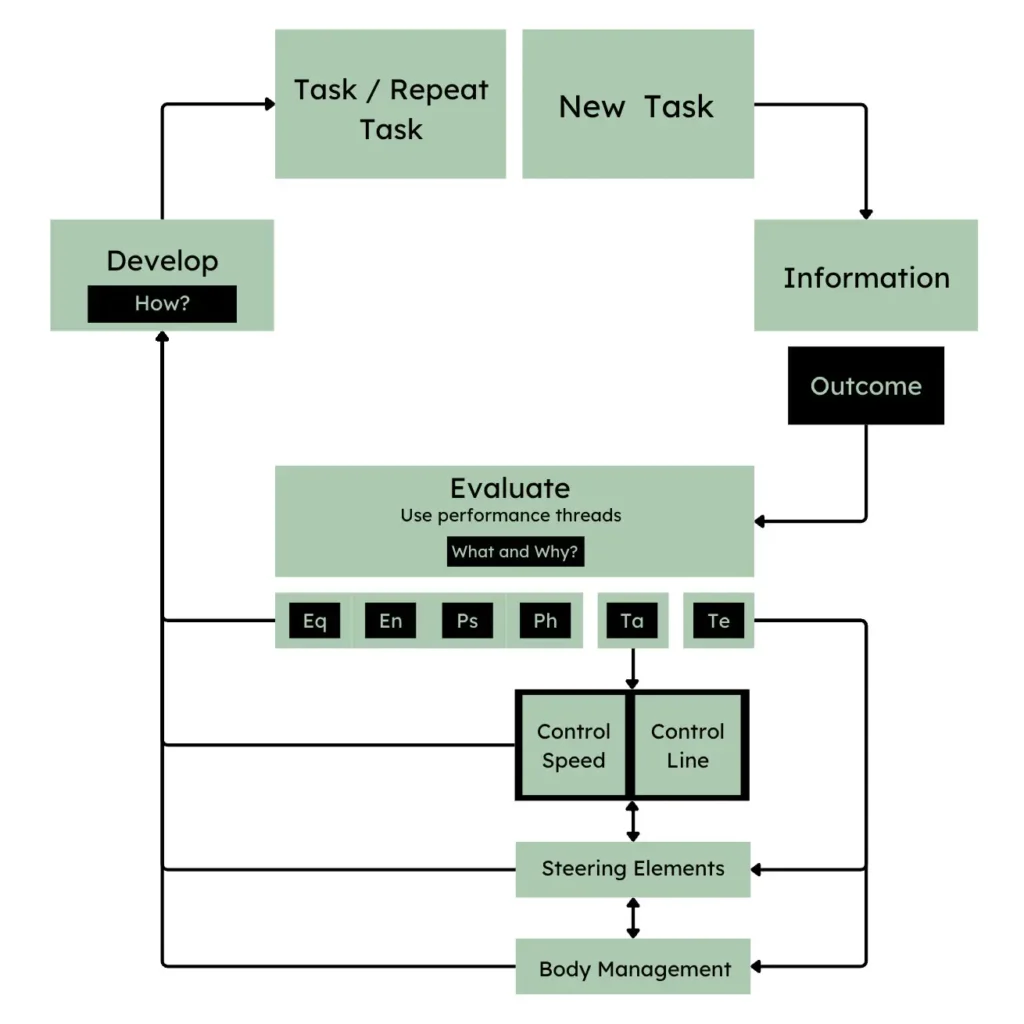
Eq – Equipment: Limitations stemming from inappropriate equipment, such as ill-fitting boots or suboptimal skis.
En – Environment: Difficult conditions, such as ice, fog, and wind, can limit progress and lead to skiing at a lower level.
Ps – Psychological: Mental blocks, such as fear of heights, speed or steep slopes. Makes progression challenging.
Ph – Physical: Restricting factors affecting the ability to ski, such as fitness, range of motion and endurance.
Ta – Tactical: Tactical changes are often easier for guests to visualise. Aim to paint a picture of these changes. Changes here can help guests unintentionally overcome other barriers.
Te – Technical: These factors are often what guests want to improve. However, the other factors mentioned need to be addressed first before technical improvements can be made.
T – Task
A successful lesson is, first and foremost, dependent on the task that you set for the learners. Think about the activity that you want the learners to do. It’s also worth considering exactly how you’ll explain the task. Your delivery will make a massive difference in how well they understand what they have to do.
The task you set should meet the following criteria.
- Specific – Clearly defined and observable.
- Appropriate – Matched to the learner’s ability and the environment.
- Achievable – Realistic within the session timeframe.
- Performance-based – Focused on observable outcomes, not just activities.
The quality of the task matters more than quantity. You’ll be assessed on your ability to select the right tool at the right time, not simply to offer more information.
I – Information
At this stage of the TIED model, you’ll gather information on outcomes relative to the task. Try to compare their ideal performance with their latest performance. You should make this comparison not from what you see but also from their perspective. What did they feel and what did they see? This should help you paint a clear picture of their overall performance.
E – Evaluation
Once you’ve gathered enough information from both your observations and the thoughts and feelings of the guest, you’ll be ready to evaluate. Draw conclusions as to why the actual performance differed from the ideal performance. The performance threads (outlined next to the TIED model diagram) will help you identify the factors most negatively affecting performance.
If there is a technical deficiency, ensure it isn’t stemming from a Physical, Psychological, Equipment, or Environmental factor first.
In practice, this can look like this: A guest has too much pressure on their inside ski. Despite telling them this, they’re unable to change it. This would be a technical fix for a technical issue. This ignores the reasons why they’re doing it in the first place and why they’re unable to change. In this case, they might be scared of the slope’s steepness (Psychological cause). This is what’s causing them to ski on their inside ski as they’re leaning away from the slope’s gradient. Address this by taking them to a shallower slope and only then working on technical development.
Effective evaluation reflects an instructor’s ability to read performance and make informed decisions rather than rigidly following a plan.
D – Development

Development focuses on what happens next based on your evaluation of their skiing. How do you want the learner to change the performance outcome, and what plan do you propose to achieve this? When you’ve identified an input that needs changing, how do they go about making these changes?
As previously mentioned, development isn’t as simple as identifying pressure on the inside ski and prescribing it on the outside ski. Look at why they’re doing it. Addressing the root causes will help you make much quicker progress.
Once you’ve addressed these factors, then look to address the initial task through a carefully selected drill or an alteration of the initial task.
For more advanced skiers, you can use the performance threads in reverse.
If they can ski perfect turns and complete the task on the first try, you could increase the difficulty by using more challenging terrain or working at a more physically demanding pace. This means that you can always achieve the right amount of difficulty for your guest.
It’s important to realise that the TIED model isn’t a linear checklist. It is a repeating cycle throughout the lesson, adapting to changing conditions, learner performance, and new insights gained from ongoing evaluation.
Once you’ve made developments, repeat the TIED model again with new or adjusted tasks.
Final Thoughts

The TIED model will help you to deliver consistent, high-quality sessions not only within your exam but also once you’re qualified as an instructor. For your BASI Level 2, instructors who apply the TIED model effectively demonstrate.
- Clear decision-making
- Learner-centred teaching
- Adaptability in diverse environments
- Purposeful progression toward meaningful outcomes
By embedding the TIED model into every session, instructors move closer to delivering lessons which are technically effective, engaging, and efficient. If you’ve got your BASI Level 2 coming up and need help with teaching and the TIED model, we can help. Our instructor training courses are led by our team with over 20 years of experience.