FR
FR  DE
DE 
What do examiners look for, and what drills can you do?
In the BASI Level 2 technical assessment, skiing bumps is a key strand. Bumps test your ability to manage terrain, absorb pressure, choose an effective line, whilst maintaining rhythm.
What are bumps?
Your BASI Level 2 bumps runs will usually take place on a slope with a blue gradient or similar. These bumps aren’t the most extreme, but they’re demanding enough to expose weaknesses.
In the context of your BASI Level 2 bumps, your examiner will be looking for you to:
- Perform continuous linked, skidded turns in easy bumps.
- Show the ability to stay in a narrow corridor.
- Maintain a constant speed.
- Use effective posture and balance.
During your bumps runs, trainers may give feedback or prompts. It’s important that you actively apply this feedback. Examiners are looking for your ability to adapt and make visible changes to your skiing.
Speed control in your BASI Level 2 bumps
In your BASI Level 2 bumps, there are three ways to control your speed. These are through:
• Turn shape – Within the bumps the amount you steer your skis will effect the amount the amount of speed whch you carry through them.
• Use of the terrain – Impacting the bumps doesn’t just help you to turn, it also helps you to slow down.
• Absorption and extension – If you impact the bumps without the absorption and extension, you’ll still find yourself speeding up.
Line selection in your BASI Level 2 bumps
The Inside or Inside Wall Line
This is the most accessible way to control speed when starting out. The goal is to turn on the top of each bump, then slide down the back side. It’s like a continuous series of hockey stops, maintaining just enough momentum to flow into the next turn.
If you choose this approach, you may lose marks for not maintaining a constant speed when being examined on your BASI Level 2 bumps.
Pros:
- Strong speed control
- Easier to manage when learning bumps
- Clear, predictable turning points
- Helps build confidence in steeper terrain
Cons:
- May struggle to stay within a narrow line
- Can appear very start/stop
- Turns are often too defensive
- Skis hit the bumps at a more side-on angle
The Outside Line
Here, your skis move out and back toward your body in a wider arc. Instead of sliding down the back of the mogul, they follow the camber on the outside of the rut, similar to skiing a berm. This line looks fluid and graceful but is faster, with speed controlled through rounder turns and some skidding. This is a very balanced approach to the bumps you’ll face in your BASI Level 2 bumps assessment.
Pros:
- Smooth, flowing appearance
- More consistent speed than the inside line
- Good use of terrain and ski-snow interaction
- Shows balance, timing, and rhythm
Cons:
- Speed can increase quickly if turns become too round
- Requires good edge control and patience
- Easier to drift wide if line choice isn’t disciplined
The Direct Line
The direct line is the fastest and most demanding approach. Your skis spend much more time in the fall line, deflecting with the terrain but rarely getting close to perpendicular to the slope. The direct line allows you to stay within a narrow corridor, which is an important element of your BASI Level 2 bumps assessment. However, this choice of line makes it difficult to avoid speeding up and losing body discipline without very strong technique.
Speed control here comes mainly from absorption. As you hit the face of each bump, flex your ankles, knees, and hips to absorb the impact. The remaining momentum will help you to initiate the next turn. This line takes practice but is extremely rewarding.
Pros:
- Keeps you within a narrow line
- Efficient and dynamic
- Demonstrates high technical ability
Cons:
- Very technically demanding
- Hard to maintain a constant speed
- Difficult to maintain body discipline
- High physical demand
Absorption in BASI Level 2 bumps
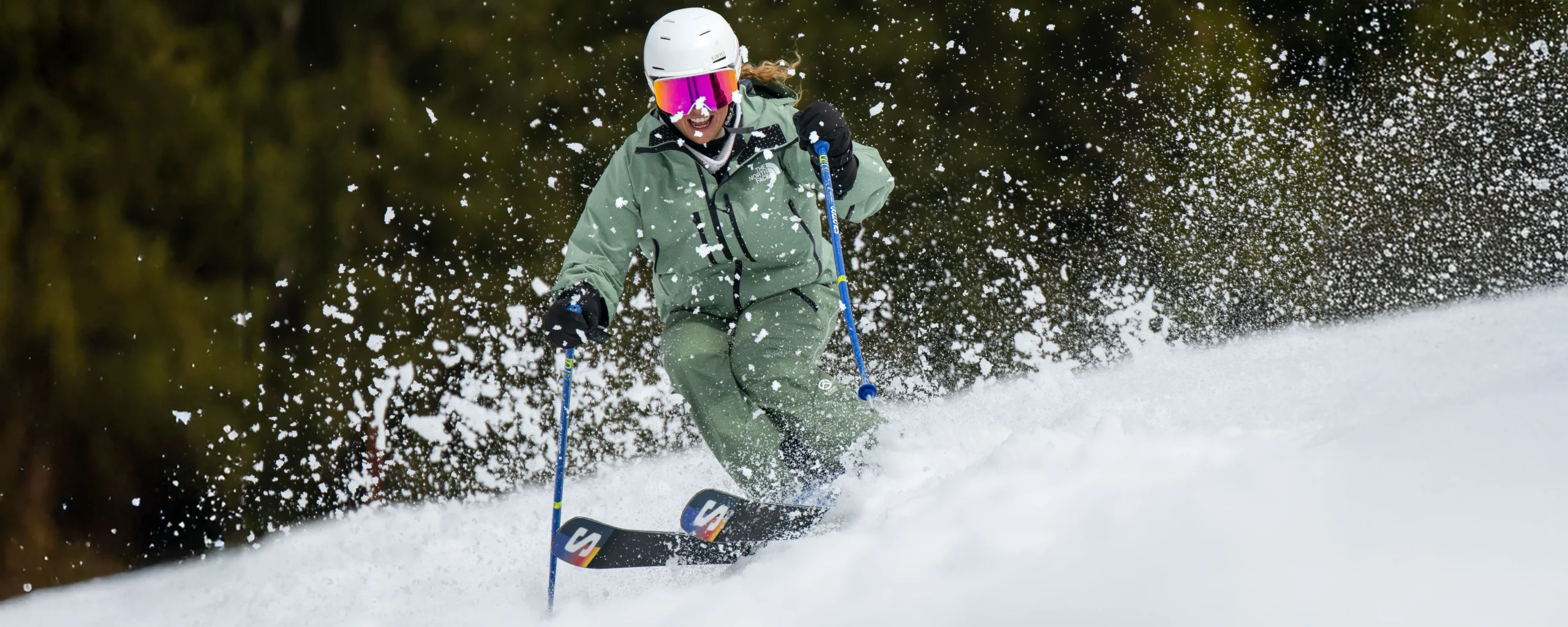
Being able to absorb the impact from bumps is a key part of the strand. Your examiner will be looking for effective absorption as part of effective posture and balance.
Your examiner will be looking for:
• Active flexion as you meet the bump
• Progressive extension into the turn
• Upper body stability while the legs move
Poor absorption leads to:
• Loss of ski-snow contact
• Late pressure
• Skidding and braking
• Disrupted rhythm
You should look supple and mobile through the legs, while your upper body remains calm and disciplined.
Rhythm and confidence – BASI Level 2 bumps
Confidence in bumps is shown through rhythm, not aggression.
Confident skiing in bumps includes:
• Consistent turn timing
• Commitment to each turn
• Quick recovery from mistakes
• Continuous movement down the slope
If confidence drops, you’ll often see:
• Hesitation at the top of the bump
• Late turning movements
• Over-rotation of the skis
• Loss of rhythm
Examiners aren’t expecting perfection, but they’re expecting composure and adaptability.
Drills to improve your BASI Level 2 bumps
Single Bump Absorption
Absorbing the impact of a bump with your lower body is an essential part of skiing bumps. If you’re faced with too many in front of you, it can be difficult to focus entirely on the absorption of the bumps.
Find well-spaced out bumps and ski a rounded line that meets the top of the bump. As you impact the bump, allow your centre of mass to be cushioned by your legs as they bend underneath you.
You should get a feeling similar to that of jumping off a low wall.
Try not to bend your legs preemptively – this will reduce your absorption. Instead, let the bump push your skis, boots and legs into your body.
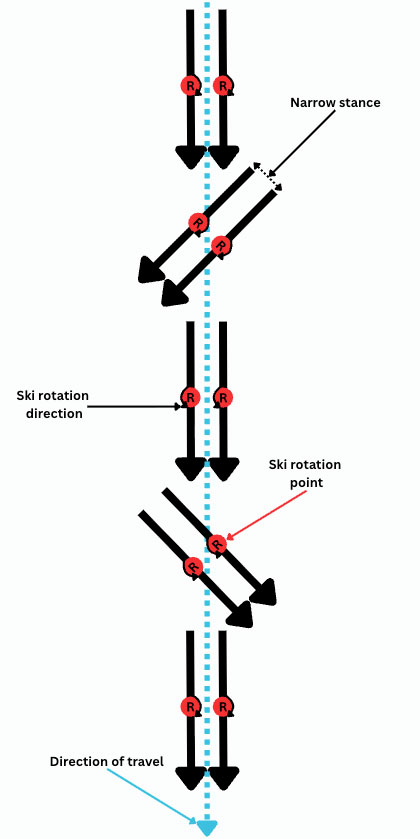
Quick feet
A narrow agile stance is also very important when skiing bumps. If your stance is too wide, then your skis will not be able to rotate quick enough and will not fit together in the trough between bumps.
If skiing with your feet close together is alien to you, try this on a flat slope with a blue or red steepness.
You’ll need to keep a very flat ski. This will let you rotate it from left to right whilst continuing to travel down the fall line. The rotation should come from the centre of the ski near to where the toe piece of the binding is.
Aim to have your skis pointing at a 45-degree angle to the left or to the right for each turn.
Technical focus areas – BASI Level 2 bumps

Absorption and Extension
Key to keeping control in the bumps. Your lower body absorbs the impact of the bumps. Make sure you don’t try to prematurely absorb the impact. This will put your body in a flexed position before impact, leaving you with no space to absorb it. As you pass the bump, extend your legs. Think about having your helmet always at the same distance from the snow. Your legs should fill in the differences between the tops of the bumps and the bottom of the bumps.
Separation
When you’re skiing bumps, rotational separation is key to performing continuous linked turns at a constant speed. If you lack this, your run will look more like a series of hockey stops on bumpy terrain. You should also aim to separate your upper body from your lower body. Your legs will be absorbing the bumps, and your upper body will be remaining stable.
Pole Plant
Bumps are much harder to ski without a solid pole plant. Your pole plant will help you to turn around the bumps, maintain upper body discipline and create a rhythm.
Tactical considerations – BASI Level 2 bumps
Commit to your line
Second-guessing your line causes hesitation and late movements. Choose a line and commit fully. Pick your first 3 to 4 bumps and then follow the line that is directly under them. If you don’t approach them confidently, then you may be rigid when interacting with them. This will reduce your ability to absorption and extend.
The ability to stay within a narrow corridor is one of the criteria which examiners mark you against. You’re much better off committing to your line and doing your best to recover technically than allowing yourself to be spat out into a wider corridor. This will fault your run in any case, so you may as well commit to the line!
Warm up appropriately
A solid warm-up is key to skiing at your best. This is the most evident in bumps. If you’re not fully warmed up, you’ll definitely lose your full range of motion. This will have the knock-on effect of making your speed more difficult to control.
The warm-up can consist of the drills mentioned within this article or those in this article, which cover the best ways to warm up.
Summary: What examiners expect – BASI Level 2 bumps
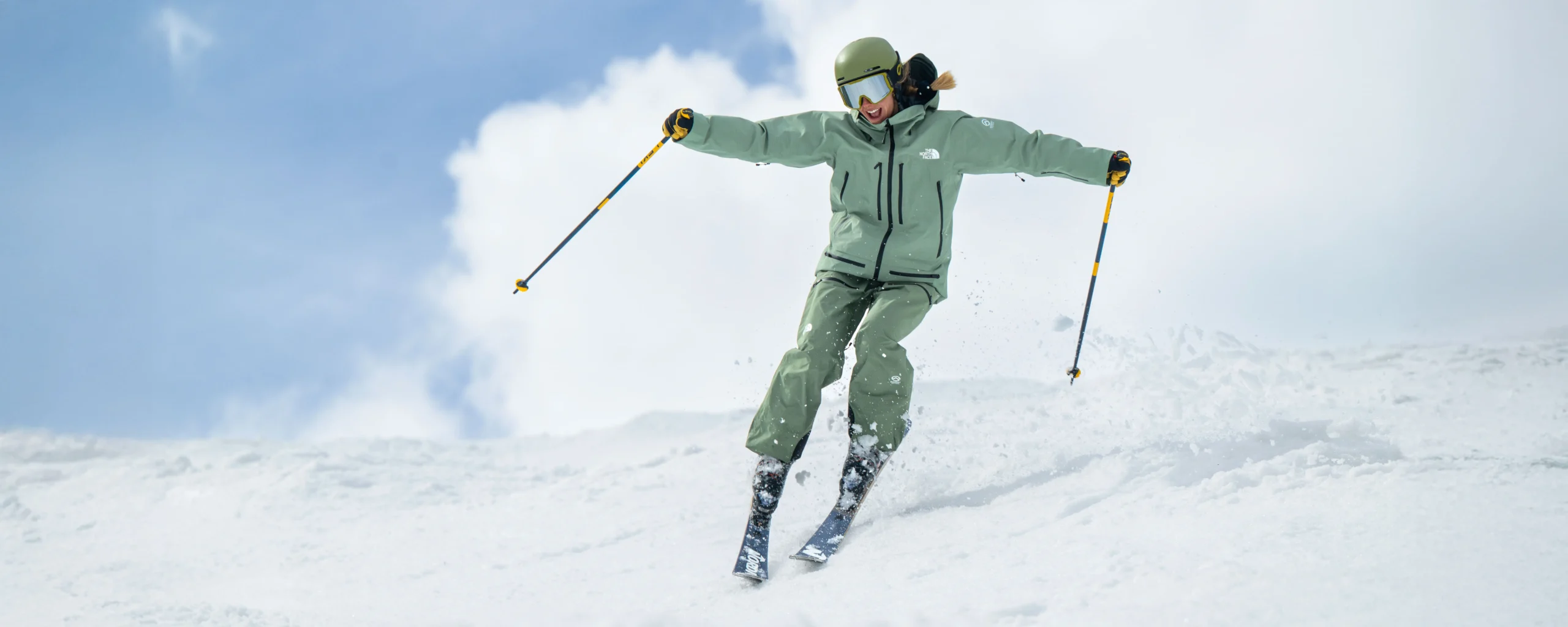
To meet the criteria for BASI Level 2 bumps, you should demonstrate:
• Speed Control – Managed through line and absorption
• Line Choice – Consistent, rounded, purposeful
• Absorption – Active, progressive, and continuous
• Balance and Posture – Calm upper body, mobile legs
• Rhythm and Flow – Linked turns with no hesitation
Mastering BASI Level 2 bumps isn’t about muscling through them. It’s about using the terrain intelligently, staying supple, and skiing with confidence and rhythm.
If you’ve got your BASI Level 2 coming up and need help with your bumps skiing, we can help. Our instructor training courses are led by our team with over 20 years of experience.